

The Interpretation Economy Is Coming for Your Lead Funnel
Picture Ethan. Ethan is a digital marketer running on iced coffee and the lingering delusion that he is a puppet master of the human psyche. Ethan is currently testing 120 different ad creatives a week, an absolutely stupid, unnecessary volume of A/B testing. He builds Facebook ads promising "tax-free wealth" and routes the poor, dopamine-addled clickers to a soul-crushingly boring life insurance form. This is the peak of the Attention Economy: a world where getting louder and catfishing the user with wildly incongruent landing pages was considered a viable, even celebrated, career path.
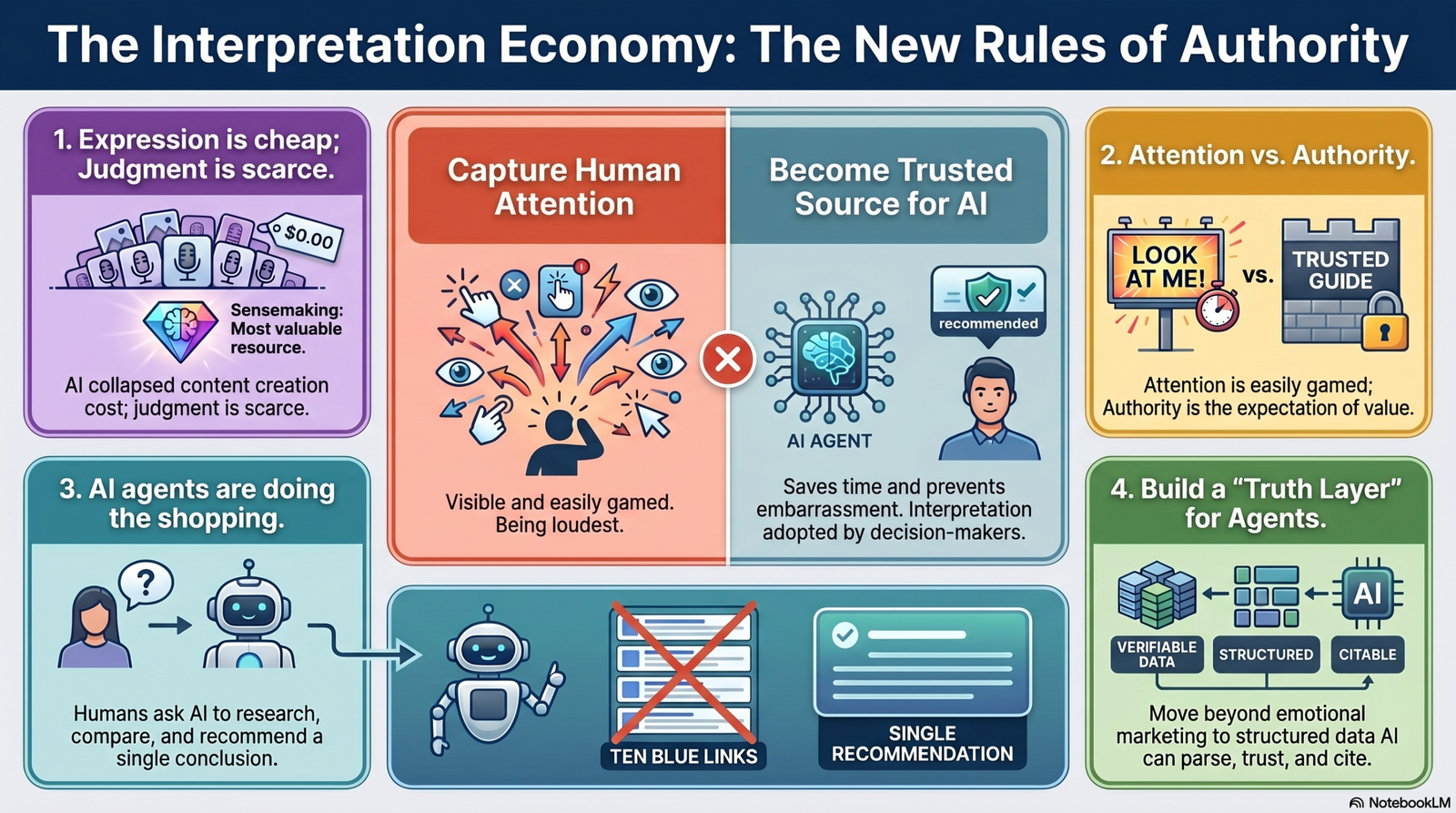
But the attention economy is breaking down. The market is saturated, and thanks to generative AI, the cost of expressing a thought has collapsed entirely. Yet, the cognitive cost of actually judging that information, of figuring out what is real and what is garbage, has not changed at all.
The Interpretation Economy
Stressed-out decision-makers, drowning in a sea of Ethan’s hyper-optimized landing pages, simply stopped reading. They don't want more information; they just want someone, anyone, to tell them what "it" means and what they should realistically do about it. They are happily outsourcing their sensemaking to whoever can save them time and prevent them from looking foolish in a 2:00 PM meeting.
Enter the AI agent. The modern consumer doesn't browse anymore; they query. When a guy wants to buy a high-end e-bike, he doesn't click through Google's ten blue links; he opens a chat window, types in his preferences, and buys exactly what the machine tells him to buy. The human shows up at the very end of the process, not the beginning.
The Funnel Implosion
The sacred marketing funnel, Awareness, Consideration, Intent, is functionally short-circuiting.
- Awareness is bypassed: AI agents don't need to be wooed by a billboard or an aesthetic brand campaign; they query structured data directly, meaning they already know your product exists without having to "discover" it.
- Consideration is compressed: An AI can read every review, parse every pricing table, and summarize the trade-offs in the time it takes a human to blink.
- Intent is invisible: The high-intent search signals that marketers used to aggressively bid on are now safely locked inside private AI conversations.
Meanwhile, traditional ad budgets are bleeding out, wasting 98% of their spend on anonymous traffic and non-converting lookalike audiences. By the time a human actually fills out one of Ethan's forms, they’ve already been pitched by three of his competitors.
The Truth Layer
So how do you exist when an automated entity, let's call it Agent Remy, is doing the shopping for the humans? You stop trying to be the loudest and you build a Truth Layer.
Agent Remy does not care about your emotionally resonant, lens-flared hero images. Remy wants verifiable facts, integration depth, and structured data that can be effortlessly extracted into a JSON schema. If you can't provide opinionated, technically clear data about why the spring system in your running shoe actually works, the AI will simply average you out, flattening your life's work into the grey paste of the internet. Being cited by an AI synthesis is the new SEO, and it is the only way you survive the initial filtering process.
For companies that need to adapt, an AI-ready lead generation system becomes part of the new infrastructure.The Two-Internet Reality & Owning Intent
We are now living in a dual reality. You must refuse to choose between the machines and the humans; you have to build for both.
For the humans, whose memory is becoming exponentially more precious, you must cultivate deep, offline brand loyalty so they constrain their AI searches by asking for you by name. For the machines, you must build agent-friendly data infrastructure.
But here is the part that makes Ethan nervous. Because Ethan still thinks lead generation is a slot machine. Put money in Meta. Put money in Google. Refresh the dashboard. Stare at the cost per lead like it is a message from God. Declare that the campaign needs “more data” when what it really needs is a reason to exist.
That era is ending.
In the Interpretation Economy, lead generation cannot be reduced to running ads and waiting for a form fill. The buyer is no longer walking through your funnel in the polite little sequence your whiteboard promised. The buyer is asking AI to narrow the field, summarize the options, expose the risks, compare the claims, and quietly remove companies that sound identical to everyone else.
So the real job is not just to buy attention. The real job is to become interpretable.
You need to know what buyers are trying to understand before they raise their hand. You need to know which problems they are researching, which competitors they are comparing, which objections are slowing them down, and which proof points will survive when a machine reduces your entire website to three sentences in a chat window.
This requires a different kind of marketing system. One that does not begin with “let’s run ads.” One that begins with demand signals, buyer questions, competitive gaps, proof, timing, and follow-up. Ads may still have a role, but they are no longer the strategy. They are one instrument inside a larger machine.
The companies that adapt will build around three disciplines:
- Signal: Understand where demand is forming before it becomes obvious. Watch the questions, searches, competitor comparisons, category shifts, and problem language buyers are already using.
- Interpretation: Make the business painfully easy to understand. Clear offers. Clear proof. Clear comparisons. Clear reasons to believe. No fog machine. No “innovative solutions for modern growth” nonsense.
- Activation: Move quickly when intent appears. Not with spam. Not with the desperate little “just following up” email. With relevant outreach that proves you understand the buyer’s problem before they have to explain it from scratch.
This is the pivot. Lead generation is no longer just a media-buying function. It is an intelligence function. It is a timing function. It is a clarity function.
The future does not belong to the company with the loudest ad budget. It belongs to the company that can be found, understood, trusted, and acted on at the exact moment a buyer is trying to make sense of the market.
You have to stop paying for attention and start building for interpretation. Authority will not come from being everywhere. It will come from being structurally useful when the decision is being made.