
LUK Digital Agency – AI-Powered Lead Generation & Automation | Orange County
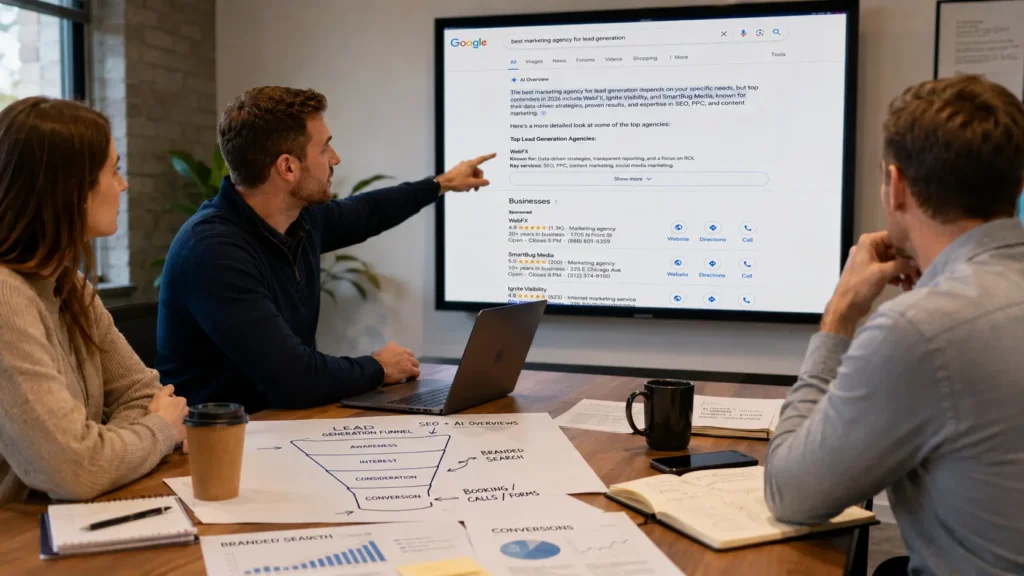
For twenty years, the deal between brands and search engines was simple. Google sent you an audience, your best content earned the click, and your website did the rest. That arrangement is quietly ending. Increasingly, the answer arrives before the click does and it's composed by AI, displayed at the top of the page, complete enough that the searcher never leaves. Visibility used to mean ranking in a list of links. Now it often means being named inside a generated answer you can't see in your analytics.
That shift is real, and it's reshaping how brands generate leads. But most of the commentary around it gets two things wrong, and getting them right is the difference between overreacting and adapting well.
First, the number everyone repeats deserves a footnote
You've seen the headline: somewhere around three-quarters of searches now end without a click. It's directionally true and worth taking seriously, but it isn't uniform. Across all queries, the zero-click rate sits closer to 60%. On searches that trigger an AI Overview specifically, it climbs past 80%. Bain's consumer research and Ahrefs' SERP analysis both land in that 80% range. And on a large category of high-value queries, AI summaries barely appear at all. Ahrefs found AI Overviews show up on under 7% of local-intent searches, versus the vast majority of informational ones.
So the honest framing isn't "75% of everything is gone." It's that the loss is concentrated — heaviest on informational, definitional queries, and lightest on the commercial and local queries closest to a purchase. The click isn't dying evenly. It's dying where it was least valuable and surviving where it mattered most.
Second, "being cited" is not the win it sounds like
The rallying cry of the moment is get cited in the answer. It's good advice, but it quietly smuggles in the old assumption that exposure equals contact. A citation is not a click. It often isn't even a visible impression. Your source can sit in a collapsed list, below the fold, or be folded into a sentence the reader never attributes to anyone. You can be cited and receive almost no traffic at all.
What a citation actually does is more subtle and more useful: it deposits a small amount of brand authority. The payoff comes later, when that person searches your name directly, or recognises you when you appear again. BrightEdge's tracking shows branded queries that display an AI Overview alongside a clear branded answer have seen roughly an 18% lift in click-through versus branded queries without one. In other words, the citation doesn't capture the lead. The citation makes the eventual branded search more likely, and that search still clicks through and converts.
This reframes the whole funnel. The first meaningful touch isn't the AI citation. It's whatever built the authority that earned the citation in the first place — reputation, reviews, first-hand expertise, word of mouth. The citation is a lagging indicator of a brand people already trust, not the origin of the relationship.
The funnel splits in two
Once you stop treating "search" as one monolithic channel, the path forward gets clearer, because intent now determines everything.
Informational queries — "how does this work," "what's the difference between X and Y" are where the click has genuinely collapsed. AI answers them in place. The painful example is the publishing playbook that dominated the last decade: comprehensive how-to libraries built to rank and capture. That content is exactly what AI Overviews summarise best, and the businesses most dependent on it have absorbed the steepest traffic declines. For lead generation, this category no longer pulls people to your site. Its only remaining value is to be the cited source — to feed the authority engine described above.
Commercial and transactional queries — "best tool for," "near me," "buy" — behave completely differently. The action still happens. But it increasingly happens on the results surface itself rather than on your website.
A real results page makes this concrete
Consider a plain "plumber near me" search. There is no AI Overview anywhere on the page that onfirms the local exception. What dominates instead is a stack of conversion surfaces, none of which require a website visit:
- At the very top, Local Services Ads which are verified providers with Get quote, Book, and Get phone number buttons built directly into the unit.
- Below that, paid text ads. Then the local map pack, where each business carries Schedule, Website, and Directions buttons, plus star ratings, hours, years in business, and a pulled review quote.
Only after all of that do the first organic links appear and the top ones belong to directories like Yelp and Angi, not individual plumbers.
The lesson isn't "the click is dead." It's that for transactional intent, the results page has become the conversion page. A customer taps Book or the phone number and the job is won, with zero visits to anyone's homepage. For a brand chasing leads, insisting on a website visit here is fighting the platform. The call and the booking are the goal, and Google is handing them out on the SERP to whoever has the reviews, the complete profile, and the booking integration to claim them.
So what is lead generation now?
It stops being traffic acquisition and becomes two distinct jobs: creating demand and capturing it across surfaces you don't fully own.
Create the demand. Because branded search is the conversion mechanism that survives, the work that matters most is the work that makes people search your name first-hand and genuinely expert content, reviews, PR, community, partnerships, and the offline and owned channels that build recognition. Google's own guidance on generative search is blunt about what earns inclusion: unique, experience-based, non-commodity content, and authentic discussion of your brand across the web. Recycled summaries of common knowledge which is the kind AI can generate itself and get nowhere. The brands that win are the ones an AI is willing to name among only three or four options, and that status is earned upstream, not hacked.
Be the source the answer prefers. This is what the industry labels AEO or GEO, though Google reasonably points out that for its own surfaces, it's just good SEO grounded in the same ranking systems. Either way, the objective has shifted from "rank first in a list" to "be the brand the model surfaces." Increasingly, AI systems function as gatekeepers that decide which companies become the default in a category. Default status is the new page one.
Capture demand wherever it converts. That means owned channels that don't depend on an algorithm — email, SMS, community — which several 2026 analyses now value at multiples of their old ROI precisely because they're insulated from search volatility. It means SERP-native conversion: complete business profiles, booking links, click-to-call, and local ads for high-intent local queries. It means retargeting the exposure you can't measure, so an invisible impression in an answer becomes an owned contact. And it means designing the content that can still earn a click — interactive tools, proprietary data, video, real comparisons — because the visitors AI does send arrive far further down the funnel. HubSpot's 2026 data found a majority of marketers report that AI-referred visitors, though fewer, are meaningfully more advanced in their buying journey.
The hardest part is measurement
A growing share of your influence is now invisible. You were named in an answer that never shows up in your traffic reports. If you keep grading lead generation on sessions and keyword rankings, you'll conclude you're failing while you're actually building authority you can't yet see.
The metrics have to move with the behaviour: branded search volume, share of voice in AI answers, direct and branded traffic, and assisted conversions which are all tied back to the only outcomes that pay the bills, which are calls, bookings, form fills, and revenue. The discipline here is resisting vanity. A zero-click impression that drives no business outcome is worth exactly nothing, no matter how good the visibility dashboard looks.
The bottom line
In 2026, lead generation is no longer "get found in the list and pull people to your site." It's build the brand authority that makes AI cite you and makes people search you by name and then capture that demand wherever it actually converts, increasingly on the answer surface itself rather than your homepage.
The single fat top-of-funnel channel is gone. In its place is a portfolio: cited content, owned audiences, SERP-native conversion, retargeting, paid, and the brand-building that feeds all of it. The website moves from being the destination to being one conversion point among several. The brands that internalise that and that stop mourning the click and start engineering for citation, branded demand, and on-surface conversion won't just survive the shift. They'll quietly take share from the competitors still waiting for their traffic to come back.