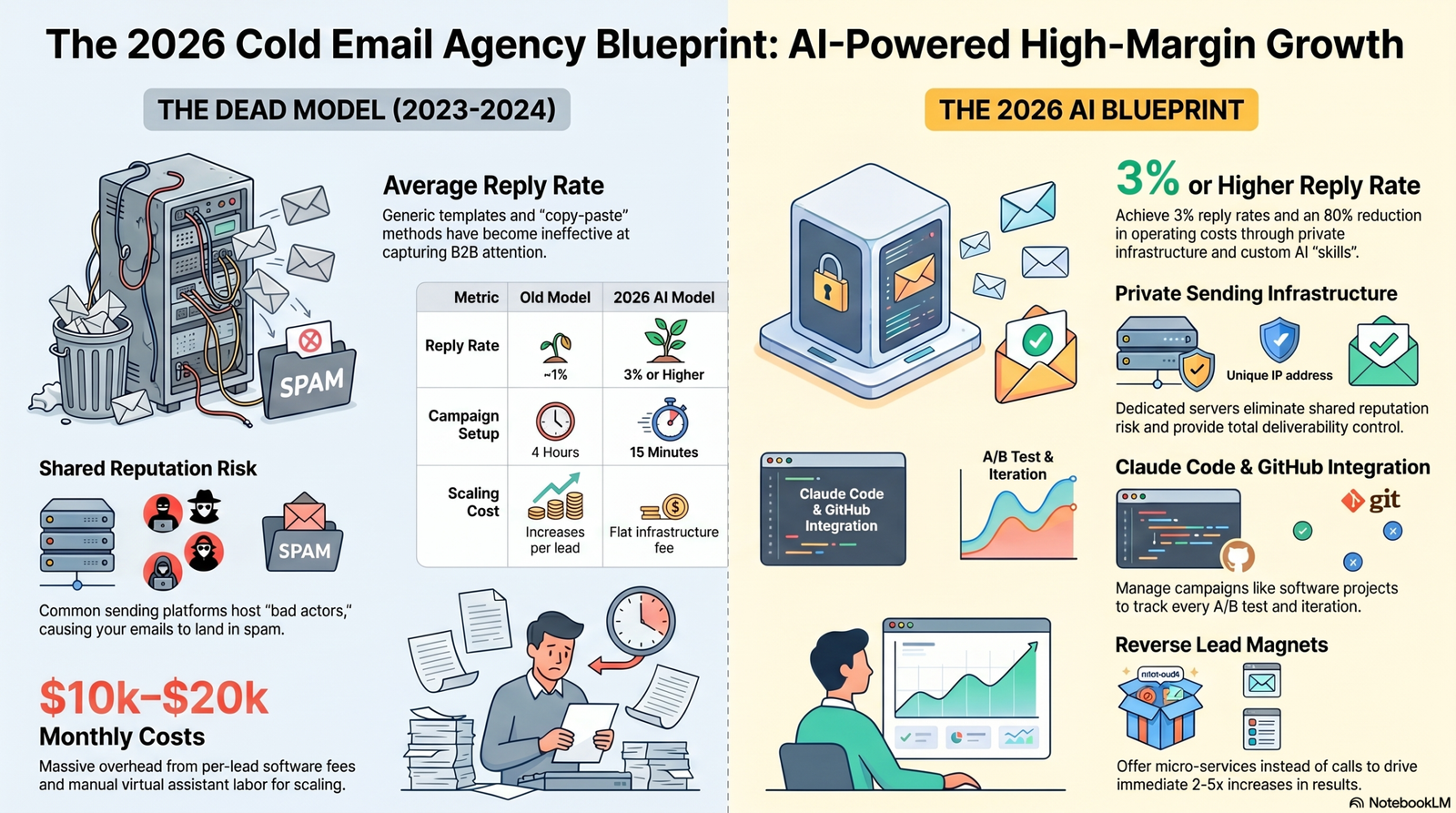
The 2026 Cold Email Blueprint: Why the 2023 Playbook Is Officially Dead
If you’re still running cold email the way agencies taught it in 2023, you’re not just behind — you’re paying premium prices for a model that no longer works. Reply rates have cratered to roughly 1%. Shared sender reputations are torching inboxes before your message ever lands. And monthly overhead for a “scaled” outbound operation now sits between $10,000 and $20,000 for results most CFOs would refuse to sign off on.
Meanwhile, a small group of operators has quietly rebuilt the entire model around AI, private infrastructure, and a software-engineering mindset. Their reply rates are hitting 3% or higher. Their campaign setup time has dropped from four hours to fifteen minutes. Their operating costs have fallen by roughly 80%.
This is the gap. And it’s only widening. Below is the full blueprint — what’s broken, what’s replacing it, and how to make the switch before your pipeline goes silent.
The 2026 Cold Email Blueprint at a glance — old model vs. AI-powered model.
The Death of the 2023–2024 Cold Email Model
Before we get to the new blueprint, it’s worth understanding exactly why the old one broke. This isn’t a minor tweak in best practices. Four foundational pillars of the 2023 model have collapsed simultaneously, and any one of them is enough to sink a campaign.
Reply rates have collapsed to ~1%
Generic templates and copy-paste personalization tokens stopped capturing B2B attention somewhere around mid-2024. Buyers now receive dozens of cold emails per week, all using the same “I noticed you’re the [Title] at [Company]” formula, all referencing the same “quick 15 minutes,” all signed off with the same forced curiosity gap. Inboxes have been trained to filter this language pattern out — both algorithmically and cognitively.
A 1% reply rate sounds tolerable until you do the math. To book ten qualified meetings, you need 1,000 replies. To get 1,000 replies at 1%, you need to send 100,000 emails. At that volume, you’re no longer running outreach — you’re running a deliverability gauntlet you’re statistically guaranteed to lose.
Shared sender reputation is killing deliverability
Most agencies still rely on common sending platforms where your domain shares IP infrastructure with thousands of other senders, including bad actors running gray-area spam campaigns. When their domains get flagged, your deliverability suffers. You inherit their reputation problems without ever doing anything wrong.
This is the silent killer of modern cold email. You can write the most personalized, valuable email in the world — and if your sending IP is on a shared block that Google or Microsoft has quietly throttled, your message lands in spam before a human ever sees it. Worse, you have no visibility into the problem until your reply rates flatline.
$10K–$20K in monthly overhead — for what?
The legacy stack stacks fees on top of fees: per-lead software pricing, contact enrichment subscriptions, deliverability tools, warming services, and a small army of virtual assistants doing the manual work the software can’t. Every additional 1,000 leads added to a campaign drives costs up linearly. There is no economy of scale.
For a mid-sized B2B operation, $10,000–$20,000 per month is now table stakes just to keep an outbound program running — before you’ve paid for a single closed deal.
Four-hour campaign setups don’t scale
The old workflow looks like this: pull a list, scrub it, segment it, write three or four email variations, plug them into the platform, configure sending schedules, set up tracking, brief the VA, and pray. Per campaign, that’s four hours of skilled marketing labor — and you’ll need to repeat the cycle every two to four weeks as messaging fatigues.
Multiply that across multiple offers, ICPs, and A/B variants, and “campaign management” quietly eats an entire FTE. That’s a hidden cost most agencies refuse to put on the line item.
The 2026 AI Cold Email Blueprint
The new model isn’t a single tool. It’s a stack — four components that, working together, replace the entire 2023 playbook with something faster, cheaper, and dramatically more effective. Here’s what each piece does and why it matters.
1. Private sending infrastructure
The first move is leaving shared platforms behind. Dedicated servers with unique IP addresses eliminate the shared-reputation problem at the root. Your domain’s deliverability is determined by your sending behavior, not the behavior of strangers on the same IP block.
The benefits compound quickly. You get total control over warming schedules, sending velocity, and reputation management. You see real-time deliverability data on every domain you operate. And critically, you can scale sending volume without inheriting someone else’s spam complaints. For agencies running outbound at any meaningful volume, this single change typically lifts inbox placement rates by 30–50%.
2. Claude Code & GitHub integration
This is where the model breaks from the marketing-tool paradigm entirely. Instead of managing campaigns inside a SaaS dashboard, top operators are now treating cold email like a software project — versioned in GitHub, automated with Claude Code, and reviewed with the same rigor engineering teams apply to production systems.
Every email variant becomes a tracked commit. Every A/B test is a branch. Every iteration is documented, reviewable, and reproducible. When something works, you know exactly which change drove the lift. When something breaks, you can roll back instantly. The compounding effect over six to twelve months is enormous: campaigns become institutional knowledge instead of tribal memory locked inside one marketer’s head.
If you’ve never thought of cold email as a software discipline, that’s the point. The agencies winning right now have.
3. Reverse lead magnets
The old offer was a calendar link. “Got 15 minutes for a quick call?” That offer is now dead on arrival — buyers know the call is a sales pitch, and the cost-benefit math doesn’t work for them.
The reverse lead magnet flips the model. Instead of asking for time, you offer a productized micro-service up front — a free audit, a custom strategy doc, a tactical asset built specifically for the recipient. The cost to deliver is low (often AI-assisted), the perceived value is high, and the conversation starts with the prospect already inside your delivery pipeline rather than guarding their calendar.
Operators who’ve adopted this approach consistently report 2–5x increases in positive replies versus traditional “book a call” CTAs. The reason is simple: you’ve moved from asking to giving, and giving converts.
4. Fifteen-minute campaign setup
When the first three pieces are in place — private infrastructure, version-controlled campaign assets, and a productized offer — campaign setup time collapses. What used to take four hours of manual list scrubbing, copywriting, and platform configuration now takes fifteen minutes of refining AI-generated drafts and pushing them live.
This isn’t just a productivity gain. It’s a structural advantage. When your competitors take four hours to launch a single campaign and you take fifteen minutes, you can run sixteen times the experiments in the same window. That’s how reply rates climb from 1% to 3%+ — not from a single magic message, but from running enough iterations to find what actually works for your ICP.
The Numbers That Actually Matter
Pull the four pieces together and the economics shift dramatically:
Reply rate: ~1% → 3% or higher (3x lift, often more)
Total operating cost: $10K–$20K/month → roughly 80% lower
The reply-rate number gets the headlines, but the cost structure is where the real margin lives. Moving from a per-lead pricing model to a flat infrastructure fee means your cost-per-meeting falls every time you scale. The old model penalized growth. The new model rewards it.
Who This Model Is Built For
Not every business needs to make this move tomorrow. The 2026 blueprint delivers the strongest returns for three groups in particular:
High-consideration B2B services. Agencies, consultants, and IT firms with deal sizes north of $10K benefit most, because the unit economics of personalized outreach finally work in their favor. When one closed deal pays for a year of infrastructure, every reply matters.
Lean sales teams. Small teams that can’t afford a full SDR org get the leverage of one without the headcount. AI handles the volume; humans handle the conversations that actually convert.
Agencies running outbound for clients. If outbound is your service offering, the margin compression of the old model is existential. The agencies that switch first will still be running outbound services in 2027. The ones that don’t, won’t.
Making the Switch
If you’re running outbound on the legacy stack today, the practical sequence looks like this:
Audit your current deliverability. Before changing anything, find out where your emails are actually landing. Most operators are shocked by the gap between “sent” and “inbox.” If you’re below 80% inbox placement, infrastructure is your bottleneck — not copy.
Migrate to private sending infrastructure. This is the single highest-leverage change. Set up dedicated servers with unique IPs, warm them properly, and move your sending off shared platforms. Expect a 30–50% lift in deliverability within the first 60 days.
Productize one offer as a reverse lead magnet. Pick your highest-converting service. Strip out the smallest valuable piece. Offer it free in your cold emails. Measure reply rate against your old “book a call” CTA. The lift will be obvious within two weeks.
Version-control your campaign assets. Get every email, sequence, and ICP definition into GitHub. Adopt the discipline of treating each variation as a commit. This pays off slowly at first and then all at once, around the six-month mark, when you can finally see what’s actually working across hundreds of iterations.
The full transition typically takes 30–60 days. The compounding gains start in week one.
The Bottom Line
The 2023 cold email model didn’t fail because cold email stopped working. It failed because the inputs that defined it — generic templates, shared infrastructure, manual labor, per-lead pricing — all degraded simultaneously. The 2026 blueprint isn’t a clever workaround. It’s a clean rebuild on better foundations: private infrastructure, AI-driven iteration, software-grade campaign management, and offers that actually respect the buyer’s time.
The agencies and B2B teams making this switch in 2026 will own their categories by 2027. The ones still defending the old model will spend the next eighteen months wondering why their pipelines went quiet.
If you want to see what the 2026 blueprint looks like applied to your outbound program — including a deliverability audit and a custom infrastructure plan — book a 15-minute AI Lead Discovery Call. We’ll walk through where your current model is leaking margin and what a private, AI-powered alternative would look like in your stack.
The Interpretation Economy Is Coming for Your Lead Funnel Picture Ethan. Ethan is a digital marketer running on iced coffee and the lingering delusion that he is a puppet master of the human psyche. Ethan is currently testing 120 different ad creatives a week, an absolutely stupid, unnecessary volume of A/B testing. He builds Facebook […]
AI-powered lead generation is moving beyond basic list building and into agent-driven prospect research, contact enrichment, sales intelligence, and human-reviewed outreach preparation.
Businesses that still rely on generic databases, stale directories, and cold email volume are working from an outdated model. The better approach is to use Claude agents to identify the right companies, find the right decision makers, enrich each lead with useful context, and prepare outreach that can be reviewed before anything is sent. This shift does not remove the need for human judgment, but it does remove much of the manual research that slows down business development.
Every few weeks, a new AI tool gets pushed into the business conversation. A YouTube creator opens a terminal, runs a few commands, shows a polished demo, and makes the whole thing look simple. The message is usually the same: install this tool, connect it to your workflow, and suddenly you have a team of AI agents helping you build, code, automate, and move faster. For business owners and agency leaders, that promise is hard to ignore because everyone is looking for leverage, especially when the goal is to generate more leads without adding more payroll, more software waste, or more complexity.
The Interpretation Economy Is Coming for Your Lead Funnel Picture Ethan. Ethan is a digital marketer running on iced coffee and the lingering delusion that he is a puppet master of the human psyche. Ethan is currently testing 120 different ad creatives a week, an absolutely stupid, unnecessary volume of A/B testing. He builds Facebook […]
AI-powered lead generation is moving beyond basic list building and into agent-driven prospect research, contact enrichment, sales intelligence, and human-reviewed outreach preparation.
Businesses that still rely on generic databases, stale directories, and cold email volume are working from an outdated model. The better approach is to use Claude agents to identify the right companies, find the right decision makers, enrich each lead with useful context, and prepare outreach that can be reviewed before anything is sent. This shift does not remove the need for human judgment, but it does remove much of the manual research that slows down business development.
Every few weeks, a new AI tool gets pushed into the business conversation. A YouTube creator opens a terminal, runs a few commands, shows a polished demo, and makes the whole thing look simple. The message is usually the same: install this tool, connect it to your workflow, and suddenly you have a team of AI agents helping you build, code, automate, and move faster. For business owners and agency leaders, that promise is hard to ignore because everyone is looking for leverage, especially when the goal is to generate more leads without adding more payroll, more software waste, or more complexity.
Contains information related to marketing campaigns of the user. These are shared with Google AdWords / Google Ads when the Google Ads and Google Analytics accounts are linked together.
90 days
__utma
ID used to identify users and sessions
2 years after last activity
__utmt
Used to monitor number of Google Analytics server requests
10 minutes
__utmb
Used to distinguish new sessions and visits. This cookie is set when the GA.js javascript library is loaded and there is no existing __utmb cookie. The cookie is updated every time data is sent to the Google Analytics server.
30 minutes after last activity
__utmc
Used only with old Urchin versions of Google Analytics and not with GA.js. Was used to distinguish between new sessions and visits at the end of a session.
End of session (browser)
__utmz
Contains information about the traffic source or campaign that directed user to the website. The cookie is set when the GA.js javascript is loaded and updated when data is sent to the Google Anaytics server
6 months after last activity
__utmv
Contains custom information set by the web developer via the _setCustomVar method in Google Analytics. This cookie is updated every time new data is sent to the Google Analytics server.
2 years after last activity
__utmx
Used to determine whether a user is included in an A / B or Multivariate test.
18 months
_ga
ID used to identify users
2 years
_gali
Used by Google Analytics to determine which links on a page are being clicked
30 seconds
_ga_
ID used to identify users
2 years
_gid
ID used to identify users for 24 hours after last activity
24 hours
_gat
Used to monitor number of Google Analytics server requests when using Google Tag Manager