The New Rules of Lead Generation: Automating the Prep, Not the Relationship
AI-powered lead generation is moving beyond basic list building and into agent-driven prospect research, contact enrichment, sales intelligence, and human-reviewed outreach preparation.
Businesses that still rely on generic databases, stale directories, and cold email volume are working from an outdated model. The better approach is to use Claude agents to identify the right companies, find the right decision makers, enrich each lead with useful context, and prepare outreach that can be reviewed before anything is sent. This shift does not remove the need for human judgment, but it does remove much of the manual research that slows down business development.
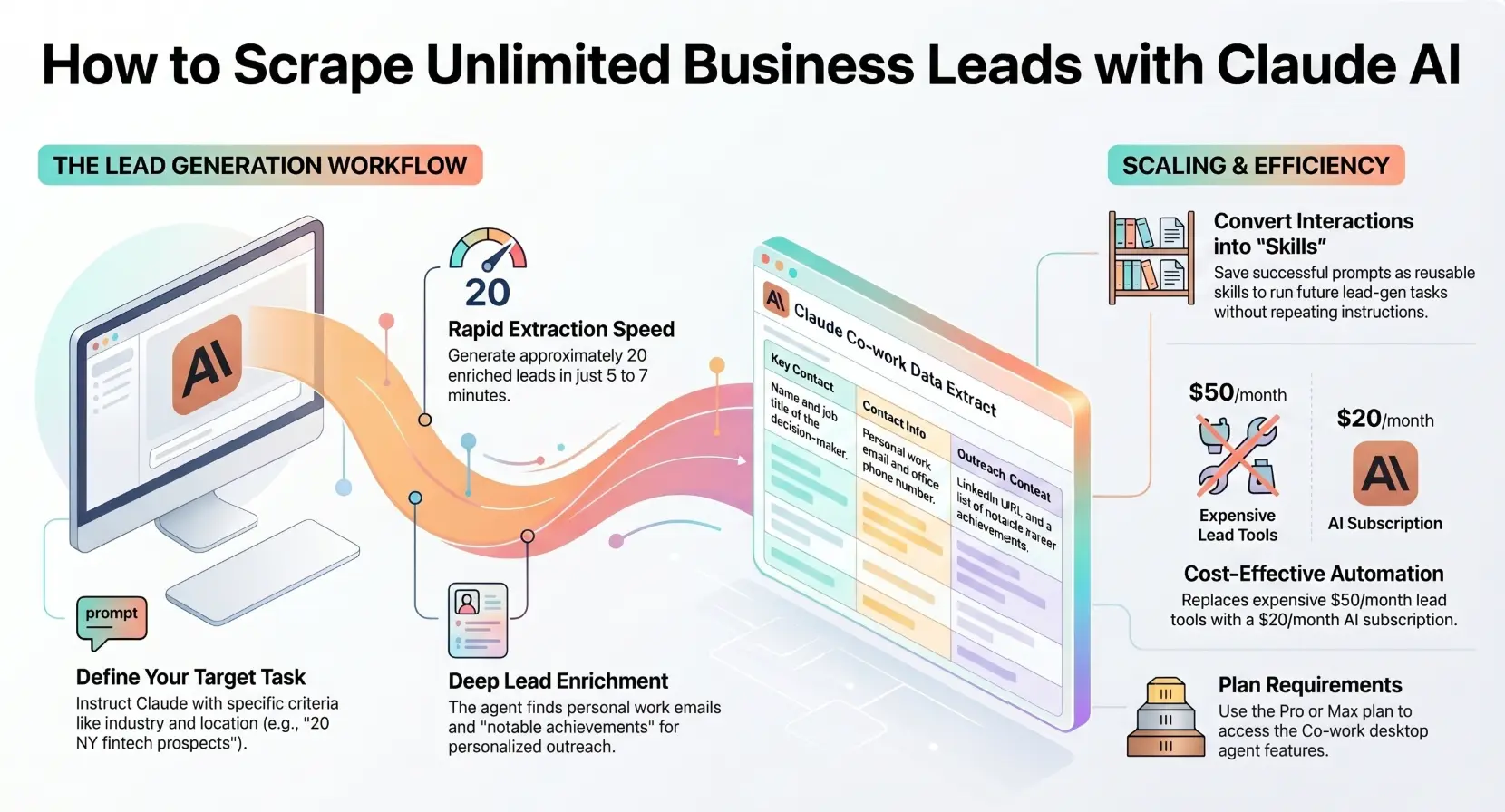
AI-powered lead generation workflow showing how modern Claude agents can identify prospects, enrich contact data, organize lead lists, and prepare personalized outreach for human review.
Traditional Lead Generation Is Breaking Down
Traditional lead generation has always created a lot of activity, but activity is not the same as a qualified sales pipeline. A business can spend hours searching Google, browsing LinkedIn, downloading lists, checking websites, and copying names into a spreadsheet without getting any closer to a meaningful conversation. The problem is the time involved, and also the quality of the data being collected. Generic email addresses, outdated contacts, unclear job titles, and weak company context make outreach harder before the first message is ever sent.
The old model was built around finding as many leads as possible and then pushing those leads into an email sequence. That approach created volume, but it also created noise because most prospects could immediately tell that the message was not based on real research. A cold email sent to a generic inbox usually starts from a position of low trust. The recipient has no reason to believe the sender understands their company, their role, their timing, or the problem they are trying to solve.
Lead generation using Claude agents changes the process by shifting the focus from raw volume to better prospect intelligence. Instead of only asking for a list of companies, a business can instruct an AI agent to find companies that match a specific industry, location, size, hiring pattern, growth signal, or business trigger. The agent can then look for decision makers, public professional profiles, company announcements, and relevant context that helps explain why the prospect may be worth contacting. This creates a stronger starting point because the outreach is based on research instead of guesswork.
Claude Agents Are More Than Chatbots
Most people still think of AI as a chatbot that answers questions inside a browser window. That is useful, but it is not the same as an AI agent that can work through a defined business process. Claude agents can be used to research, compare, organize, summarize, and structure information around a specific objective. In a lead generation workflow, that means Claude can act more like a digital sales research assistant than a simple writing tool.
The difference matters because prospecting is not one simple task. Effective B2B lead generation usually includes target market definition, company discovery, contact research, lead enrichment, qualification, outreach preparation, CRM organization, and follow-up planning. A chatbot may help write a message after the lead is found, but a Claude agent can help with the upstream work that determines whether the message should be sent in the first place. That makes the agent useful earlier in the sales development process, where better research can prevent wasted outreach.
When businesses use Claude agents correctly, they are not just asking AI to write a nicer cold email. They are building a repeatable lead generation workflow that can be reused across industries, regions, and customer segments. The same structure can be adapted for fintech companies in New York, SaaS startups in London, dental practices in California, commercial real estate firms, law offices, manufacturing companies, healthcare organizations, or local service businesses. The target changes, but the underlying workflow remains consistent.
Better Lead Generation Starts With Better Instructions
Claude agents are powerful, but they still need strong instructions. If a business asks for “leads,” the output will often be too broad because the agent has not been given enough criteria to separate a useful prospect from a weak one. A stronger instruction defines the target industry, geography, company type, decision maker role, preferred contact fields, enrichment requirements, and format of the final output. The quality of the lead generation workflow depends heavily on the quality of the operating instructions.
A weak prompt might ask Claude to find twenty companies in a market. A stronger workflow asks Claude to find twenty companies that match a specific ideal customer profile, identify the likely decision maker, avoid generic company inboxes when possible, include public professional profile links, capture recent business activity, and organize the findings into a structured lead list. That distinction is important because most businesses do not need more random names. They need better-qualified prospects with enough context to support relevant outreach.
This is where AI lead enrichment becomes valuable. Claude can help gather details that make each prospect easier to understand, such as company description, location, target market, leadership role, recent announcements, hiring activity, awards, partnerships, funding news, expansion signals, or other business triggers. These details do not guarantee a sale, but they help the human reviewer decide whether the prospect belongs in the campaign. Lead generation becomes more strategic when the list includes context, not just contact information.
Generic Emails Should Not Be the Standard
One of the biggest weaknesses in traditional prospecting is the acceptance of generic email addresses as usable leads. Addresses like “info@,” “contact@,” and “sales@” are easy to find, but they usually do not connect the message to the person who can make a decision. They may work for some local service inquiries, but they are usually weak for B2B outreach, partnership development, high-ticket services, and consultative sales. A serious lead generation workflow should treat generic emails as a fallback, not as the preferred result.
Lead generation using Claude agents should push toward decision-maker identification first. The agent should be directed to look for founders, owners, executives, department heads, marketing leaders, operations leaders, HR leaders, practice administrators, managing partners, or other roles tied to the offer being sold. Once the person is identified, the workflow can look for professional email patterns, public profiles, company pages, and supporting context. This creates a stronger outreach foundation than sending messages into an inbox that may never be reviewed by the right person.
Businesses still need to be careful with data quality, privacy, and outreach compliance. AI can help gather and organize public business information, but human review is required before using that information in sales campaigns. Contact data should be checked, cleaned, and used responsibly. The goal is not to scrape without judgment, but to build a more intelligent prospecting workflow that respects brand reputation and improves relevance.
Context Is the Real Competitive Advantage
The word personalization has been weakened by bad marketing automation. Many businesses call an email personalized because it includes a first name, company name, or industry reference. That is not meaningful personalization. Real personalization comes from understanding what is happening with the prospect and using that context to decide whether the conversation is relevant.
Claude agents can help find the kind of context that makes outreach more credible. This may include a new location opening, a recent funding round, a leadership hire, a product launch, an acquisition, an award, a hiring push, a website update, a compliance need, a seasonal demand shift, or a visible operational challenge. When that information is organized next to the prospect record, the outreach becomes easier to review and easier to customize. The salesperson or business owner is no longer starting from a blank screen.
Context also helps with lead scoring and prioritization. A company that recently expanded, hired new staff, launched a new service, or announced a growth initiative may deserve a different outreach angle than a company with no visible activity. Claude can help summarize these signals so a human can decide which leads deserve immediate attention. This improves the efficiency of outbound sales because the team can focus on prospects with stronger reasons for engagement.
Turning Claude Lead Research Into a Repeatable Workflow
The most useful part of lead generation using Claude agents is not a single research session. The real value comes from turning a successful process into a repeatable workflow. Once the business defines the criteria, enrichment rules, quality standards, and output format, the same structure can be reused for future campaigns. This is how AI moves from being a one-time helper to becoming part of the company’s sales development system.
A repeatable Claude lead generation workflow should include clear inputs and clear outputs. The inputs may include target industry, city, company size, decision maker role, excluded lead types, preferred data sources, contact fields, and enrichment requirements. The outputs should include a structured spreadsheet or CRM-ready lead file with columns for company name, website, industry, location, contact name, title, professional profile, email, phone, recent activity, outreach angle, lead score, and review status. This structure makes the lead list easier to verify, import, assign, and act on.
The workflow can also be improved over time as the business learns which leads convert. If certain titles respond better, those titles can be prioritized in the next search. If certain industries produce weak meetings, those industries can be removed or segmented differently. If certain business triggers create stronger conversations, those triggers can become required enrichment fields in future Claude agent instructions.
AI Can Prepare Outreach, But It Should Not Own the Relationship
Claude agents can help draft personalized outreach messages based on the lead data and context gathered during research. This can save time because the human sender does not have to start every email, LinkedIn message, call note, or direct mail idea from scratch. The agent can produce a first draft that references the prospect’s role, company, recent activity, and possible business need. That draft can then be reviewed, edited, shortened, strengthened, or rejected by the human operator.
The final send should not be fully automated without review. AI can misread context, misunderstand tone, overstate a claim, or reference information in a way that feels invasive or inaccurate. A message that looks efficient inside a workflow can still damage trust if it reaches the wrong person with the wrong assumption. Human judgment protects the brand, especially when outreach is being sent to executives, owners, partners, or professional buyers.
The better model is to automate the preparation, not the relationship. Claude agents can gather the information, organize the lead file, draft the message, and suggest the outreach angle. The human still decides whether the prospect is qualified, whether the message is appropriate, and whether the timing makes sense. This balance allows businesses to scale research without turning their outreach into spam.
Small Businesses Should Pay Attention
Larger companies have traditionally had an advantage because they could afford sales intelligence platforms, data enrichment tools, prospecting teams, CRM administrators, and outbound sales systems. Small businesses often had to rely on referrals, manual research, purchased lists, or inconsistent cold outreach. Claude agents reduce part of that gap by helping smaller teams perform research and organization that previously required more time or more software. This does not make strategy unnecessary, but it does make execution more accessible.
For agencies, consultants, local service providers, B2B companies, and niche firms, the opportunity is practical. A small team can define an ideal customer profile, use Claude for prospect research, enrich each lead with business context, prepare a structured outreach file, and review the final messaging before launching a campaign. This creates a more disciplined outbound process without immediately hiring a full sales development team. It also gives the business a clearer view of which markets, titles, and messages are worth testing.
The businesses that get the best results will not be the ones that treat Claude as a magic lead machine. They will be the ones that define their offer clearly, choose a specific market, set strict lead quality rules, review the data, and improve the workflow based on results. Claude agents can accelerate prospecting, but they cannot replace positioning, offer clarity, sales judgment, or follow-through. Those business fundamentals still determine whether lead generation turns into revenue.
Final Takeaway
Lead generation using Claude agents is not about blasting more cold emails to more people. It is about building a smarter process for finding the right prospects, enriching the data, understanding the context, and preparing outreach that deserves human review. The businesses that win with this approach will use AI to remove repetitive research work while keeping control over message quality and relationship development. That is the difference between using automation to create noise and using automation to create better sales opportunities.
The practical formula is straightforward. Use Claude agents to define the target market, research companies, identify decision makers, enrich the lead record, organize the data, and prepare outreach drafts. Then use human judgment to verify the list, adjust the message, and decide what gets sent. That is how small businesses can build a more effective lead generation system without losing the trust and credibility required to turn prospects into clients.
AI-powered lead generation is moving beyond basic list building and into agent-driven prospect research, contact enrichment, sales intelligence, and human-reviewed outreach preparation.
Businesses that still rely on generic databases, stale directories, and cold email volume are working from an outdated model. The better approach is to use Claude agents to identify the right companies, find the right decision makers, enrich each lead with useful context, and prepare outreach that can be reviewed before anything is sent. This shift does not remove the need for human judgment, but it does remove much of the manual research that slows down business development.
Every few weeks, a new AI tool gets pushed into the business conversation. A YouTube creator opens a terminal, runs a few commands, shows a polished demo, and makes the whole thing look simple. The message is usually the same: install this tool, connect it to your workflow, and suddenly you have a team of AI agents helping you build, code, automate, and move faster. For business owners and agency leaders, that promise is hard to ignore because everyone is looking for leverage, especially when the goal is to generate more leads without adding more payroll, more software waste, or more complexity.
Every new launch arrives with the same promise: less busywork, better decisions, faster execution, and a team that suddenly has more capacity. That sounds good.
It is also how companies end up with ten tools, five disconnected pilots, three nervous managers, and no clear answer to whether anything actually improved. The problem is not that AI agents are overhyped. Some of them are genuinely useful. The problem is that most companies are asking the wrong question.
AI-powered lead generation is moving beyond basic list building and into agent-driven prospect research, contact enrichment, sales intelligence, and human-reviewed outreach preparation.
Businesses that still rely on generic databases, stale directories, and cold email volume are working from an outdated model. The better approach is to use Claude agents to identify the right companies, find the right decision makers, enrich each lead with useful context, and prepare outreach that can be reviewed before anything is sent. This shift does not remove the need for human judgment, but it does remove much of the manual research that slows down business development.
Every few weeks, a new AI tool gets pushed into the business conversation. A YouTube creator opens a terminal, runs a few commands, shows a polished demo, and makes the whole thing look simple. The message is usually the same: install this tool, connect it to your workflow, and suddenly you have a team of AI agents helping you build, code, automate, and move faster. For business owners and agency leaders, that promise is hard to ignore because everyone is looking for leverage, especially when the goal is to generate more leads without adding more payroll, more software waste, or more complexity.
Every new launch arrives with the same promise: less busywork, better decisions, faster execution, and a team that suddenly has more capacity. That sounds good.
It is also how companies end up with ten tools, five disconnected pilots, three nervous managers, and no clear answer to whether anything actually improved. The problem is not that AI agents are overhyped. Some of them are genuinely useful. The problem is that most companies are asking the wrong question.
Contains information related to marketing campaigns of the user. These are shared with Google AdWords / Google Ads when the Google Ads and Google Analytics accounts are linked together.
90 days
__utma
ID used to identify users and sessions
2 years after last activity
__utmt
Used to monitor number of Google Analytics server requests
10 minutes
__utmb
Used to distinguish new sessions and visits. This cookie is set when the GA.js javascript library is loaded and there is no existing __utmb cookie. The cookie is updated every time data is sent to the Google Analytics server.
30 minutes after last activity
__utmc
Used only with old Urchin versions of Google Analytics and not with GA.js. Was used to distinguish between new sessions and visits at the end of a session.
End of session (browser)
__utmz
Contains information about the traffic source or campaign that directed user to the website. The cookie is set when the GA.js javascript is loaded and updated when data is sent to the Google Anaytics server
6 months after last activity
__utmv
Contains custom information set by the web developer via the _setCustomVar method in Google Analytics. This cookie is updated every time new data is sent to the Google Analytics server.
2 years after last activity
__utmx
Used to determine whether a user is included in an A / B or Multivariate test.
18 months
_ga
ID used to identify users
2 years
_gali
Used by Google Analytics to determine which links on a page are being clicked
30 seconds
_ga_
ID used to identify users
2 years
_gid
ID used to identify users for 24 hours after last activity
24 hours
_gat
Used to monitor number of Google Analytics server requests when using Google Tag Manager