LUK Digital Agency – AI-Powered Lead Generation & Automation | Orange County

The Salty Pretzel Strategy: How AI Turns Strangers Into Buyers

Business professional reviewing an AI-generated marketing report while being offered a salted pretzel, symbolizing a free value offer that turns prospects into buyers.

Most lead generation is broken in the same way: you ask for marriage on the first date.

A cold prospect lands on your site, sees a “Book a Call” button, and is expected to hand over thirty minutes of their life to a stranger pitching a five-figure service. Conversion rates hover around 1%. The relationship starts cold and skeptical, and most of the funnel is friction.

There is a better way, and it has a name.
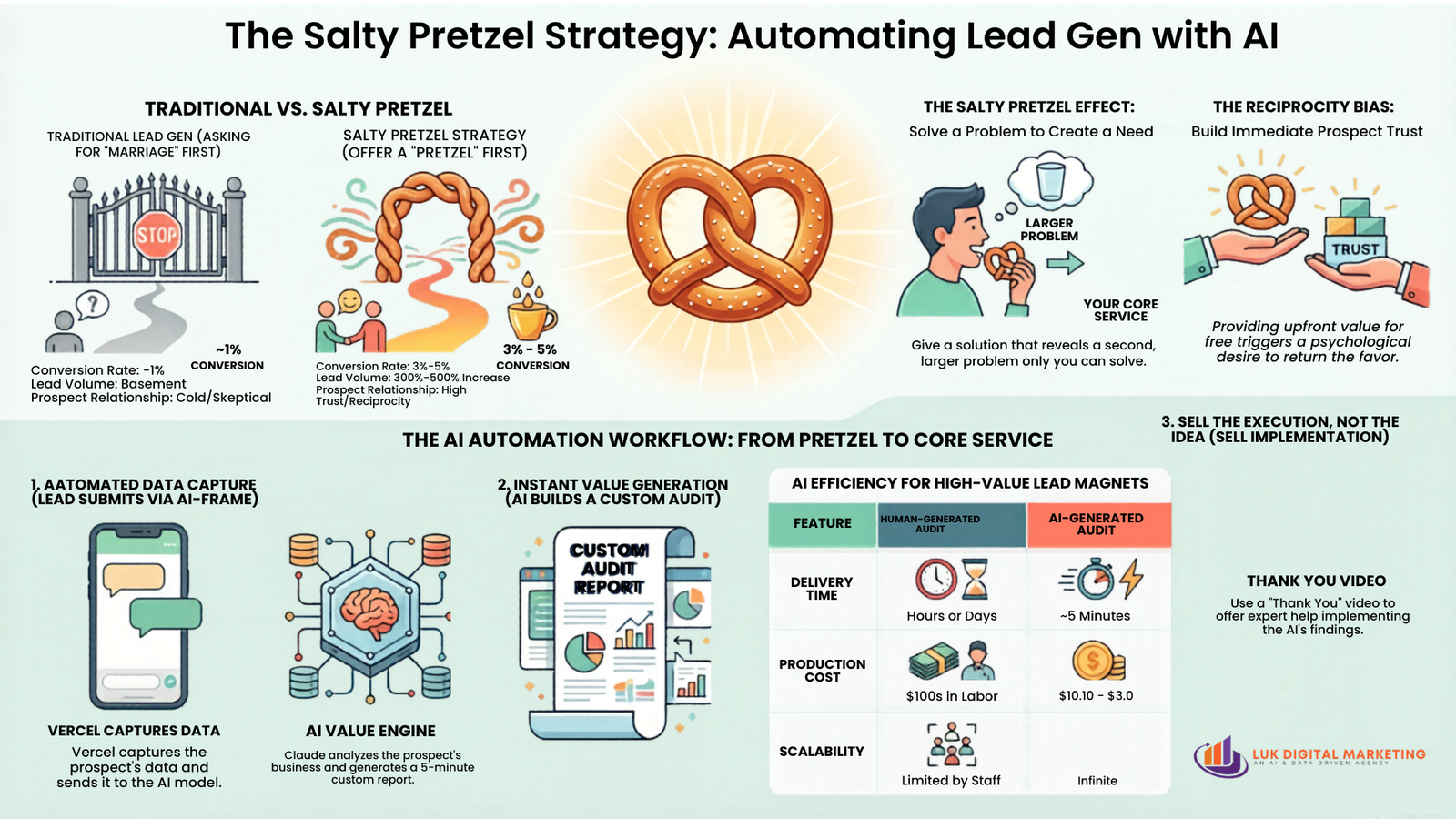
The Salty Pretzel Strategy: Automating Lead Gen with AI — infographic comparing traditional lead gen with the salty pretzel approach, the reciprocity bias, and the AI automation workflow

What the Salty Pretzel Strategy Actually Is

The “Salty Pretzel” is a framework popularized by Alex Hormozi. It is, by his own account, often the first lever he pulls when he invests in a portfolio company that is struggling with lead generation.

The metaphor is simple. Imagine you own a bar. You can sell people drinks all night, but the math only works if they are thirsty. So instead of standing at the door pitching beers, you hand every guest a free salty pretzel as they walk in. The pretzel solves a small problem (hunger) and creates a much bigger one (thirst), which your bar happens to be the perfect place to solve.

In business terms: give away a small, valuable, narrowly-scoped solution for free. That solution naturally reveals a second, larger problem that only your core service can solve.

The numbers tell the story:

 Traditional Lead GenSalty Pretzel Strategy
Conversion Rate~1%3% – 5%
Lead VolumeBaseline300% – 500% increase
Prospect RelationshipCold / skepticalHigh trust / reciprocity

Cialdini’s Reciprocity Bias

Hormozi popularized the tactic, but the psychology underneath is much older. In Influence: The Psychology of Persuasion, Robert Cialdini identified reciprocity as one of the most powerful drivers of human behavior. When someone gives us something of value, we feel a near-automatic pull to return the favor.

This is not a rational calculation. It is a deeply wired social instinct that predates capitalism by tens of thousands of years. Hare Krishna fundraisers used it to extraordinary effect by handing flowers to travelers in airports. Restaurants use it when a server brings a free mint with the bill and tips go up. Charities use it when they include free address labels in their mailers.

When you give a prospect a genuinely useful, custom-built piece of value before asking for anything in return, you are not just being generous. You are triggering a psychological response that makes them significantly more likely to engage with your paid offer later. The pretzel is not a gimmick; it is the relationship.

The Problem the Salty Pretzel Used to Have

Here is the catch that has historically limited this strategy: a good pretzel is expensive to produce.

If your free offer is a custom audit, a personalized strategy doc, or a tailored analysis, you used to need a human analyst to build it. That meant hours of labor per lead, hundreds of dollars in cost, and a delivery window measured in days. The strategy worked, but it did not scale. Most companies ended up shipping a generic PDF instead and wondered why the magic was missing. This is exactly where AI changes the equation.

The AI Automation Workflow: From Pretzel to Core Service

The modern Salty Pretzel runs on three steps, all automated:

1. Automated Data Capture. A prospect submits their information through a lead form embedded on your site. The form sends the data straight to the AI model. No spreadsheets, no manual handoff.

2. Instant Value Generation. An AI model (in our stack, Claude) analyzes the prospect’s specific business and generates a genuinely custom audit report in roughly five minutes. Not a templated PDF with their name swapped in. A real, contextual analysis of their situation.

3. Sell the Execution, Not the Idea. The audit lands in their inbox alongside a short thank-you video. The video acknowledges that the report identifies real opportunities, and offers expert help implementing what the AI surfaced. You give away the diagnosis. You sell the treatment.

The economics are unrecognizable from the human-only version:

FeatureHuman-Generated AuditAI-Generated Audit
Delivery TimeHours or days~5 minutes
Production Cost$100s in labor$0.10 – $0.30
ScalabilityLimited by staffEffectively infinite

A pretzel that used to cost $300 to make and took three days to deliver now costs thirty cents and arrives before the prospect has closed the tab. That changes what is possible.

“Sell the Execution” Is the Whole Game

The most common mistake I see businesses make when they first try this is treating the audit as the product. It is not. The audit is the pretzel.

A good AI-generated report will identify five to ten real issues in a prospect’s business. Most of those issues are things the prospect could theoretically fix themselves, given enough time, expertise, and willingness to learn entirely new disciplines. They will not. They will look at the list, feel the weight of it, and want someone to handle it for them.

That is your core service. The audit creates the awareness. The reciprocity creates the trust. The thank-you video creates the path. The sale closes itself.


Business professional reviewing an AI-generated marketing report while being offered a salted pretzel, symbolizing a free value offer that turns prospects into buyers.
Marketing professional analyzing a lead generation dashboard with AI scoring, visitor identification, predictive analytics, and multichannel outreach data.

The Honest Caveat

A few things worth saying out loud:

The strategy only works if the pretzel is genuinely good. A lazy AI prompt that produces a generic report will erode trust, not build it. The prompt engineering on the audit itself is where most of the work lives.

The conversion lift assumes you have a real core offer that the audit logically points toward. If your audit identifies SEO problems but you sell accounting software, the funnel breaks.

And finally: 3-5% conversion on warm, high-intent leads is excellent, but it is not magic. The 300-500% lead volume increase is doing a lot of the work in the total revenue math. Both numbers matter.

The Pretzel Catches Some of Them. The Rest Need a Different Tool.

Here is the uncomfortable truth that does not fit on the infographic: even with a great pretzel, most of the buyers in your market will never fill out your form. Some are still researching. Some are quietly comparing you to three competitors. Some are ready to buy but will never raise their hand on a stranger’s website.

By the time they finally do convert, they have already talked to three other people. You were never even in the room.

A complete pipeline has to catch all of them, not just the ones polite enough to volunteer. That is why we built the LUK Digital system as three integrated products:

  1. LeadFinder identifies buyers while they are still searching. It monitors keyword intent and competitor site activity across your entire market, so you know who is shopping in your category before they ever land on your page.
  2. LeadID unmasks the anonymous traffic that already visits your site and bounces without converting. IP addresses become real people with verified personal and work emails, LinkedIn profiles, and direct CRM sync. The 98% of your traffic that used to be invisible becomes a working list.
  3. LeadConnect then deploys hyper-personalized AI outreach the moment intent is detected — across multiple channels, automatically, while the buyer is still in market and before your competitors know they exist.

The salty pretzel converts the visitors who self-identify. LeadFinder, LeadID, and LeadConnect convert the ones who never would have. Together, they own the full demand pipeline from first signal to closed deal.

Book a 15-minute AI Lead Discovery Call and we will show you exactly how many active buyers are in your category right now — most of whom your current funnel will never see.

Hand out the pretzel. Then catch everyone walking past it.

Recent Post

The Interpretation Economy Is Coming for Your Lead Funnel

The Interpretation Economy Is Coming for Your Lead Funnel

The Interpretation Economy Is Coming for Your Lead Funnel Picture Ethan. Ethan is a digital marketer running on iced coffee and the lingering delusion that he is a puppet master of the human psyche. Ethan is currently testing 120 different ad creatives a week, an absolutely stupid, unnecessary volume of A/B testing. He builds Facebook […]

The New Rules of Lead Generation: Automating the Prep, Not the Relationship

The New Rules of Lead Generation: Automating the Prep, Not the Relationship

AI-powered lead generation is moving beyond basic list building and into agent-driven prospect research, contact enrichment, sales intelligence, and human-reviewed outreach preparation.


Businesses that still rely on generic databases, stale directories, and cold email volume are working from an outdated model. The better approach is to use Claude agents to identify the right companies, find the right decision makers, enrich each lead with useful context, and prepare outreach that can be reviewed before anything is sent. This shift does not remove the need for human judgment, but it does remove much of the manual research that slows down business development.

Ruflo and the Risk of Chasing the Latest AI Agent Before You Understand the Cost

Ruflo and the Risk of Chasing the Latest AI Agent Before You Understand the Cost

Every few weeks, a new AI tool gets pushed into the business conversation. A YouTube creator opens a terminal, runs a few commands, shows a polished demo, and makes the whole thing look simple. The message is usually the same: install this tool, connect it to your workflow, and suddenly you have a team of AI agents helping you build, code, automate, and move faster. For business owners and agency leaders, that promise is hard to ignore because everyone is looking for leverage, especially when the goal is to generate more leads without adding more payroll, more software waste, or more complexity.

The Interpretation Economy Is Coming for Your Lead Funnel

The Interpretation Economy Is Coming for Your Lead Funnel

The Interpretation Economy Is Coming for Your Lead Funnel Picture Ethan. Ethan is a digital marketer running on iced coffee and the lingering delusion that he is a puppet master of the human psyche. Ethan is currently testing 120 different ad creatives a week, an absolutely stupid, unnecessary volume of A/B testing. He builds Facebook […]

The New Rules of Lead Generation: Automating the Prep, Not the Relationship

The New Rules of Lead Generation: Automating the Prep, Not the Relationship

AI-powered lead generation is moving beyond basic list building and into agent-driven prospect research, contact enrichment, sales intelligence, and human-reviewed outreach preparation.


Businesses that still rely on generic databases, stale directories, and cold email volume are working from an outdated model. The better approach is to use Claude agents to identify the right companies, find the right decision makers, enrich each lead with useful context, and prepare outreach that can be reviewed before anything is sent. This shift does not remove the need for human judgment, but it does remove much of the manual research that slows down business development.

Ruflo and the Risk of Chasing the Latest AI Agent Before You Understand the Cost

Ruflo and the Risk of Chasing the Latest AI Agent Before You Understand the Cost

Every few weeks, a new AI tool gets pushed into the business conversation. A YouTube creator opens a terminal, runs a few commands, shows a polished demo, and makes the whole thing look simple. The message is usually the same: install this tool, connect it to your workflow, and suddenly you have a team of AI agents helping you build, code, automate, and move faster. For business owners and agency leaders, that promise is hard to ignore because everyone is looking for leverage, especially when the goal is to generate more leads without adding more payroll, more software waste, or more complexity.